
Caracterización preliminar de dos fermentos de kéfir de agua después de cinco días
DOI:
https://doi.org/10.70881/mcj/v4/n4/186Palabras clave:
fermentación no láctea, bacterias ácido-lácticas, levaduras, panela, tinción de GramResumen
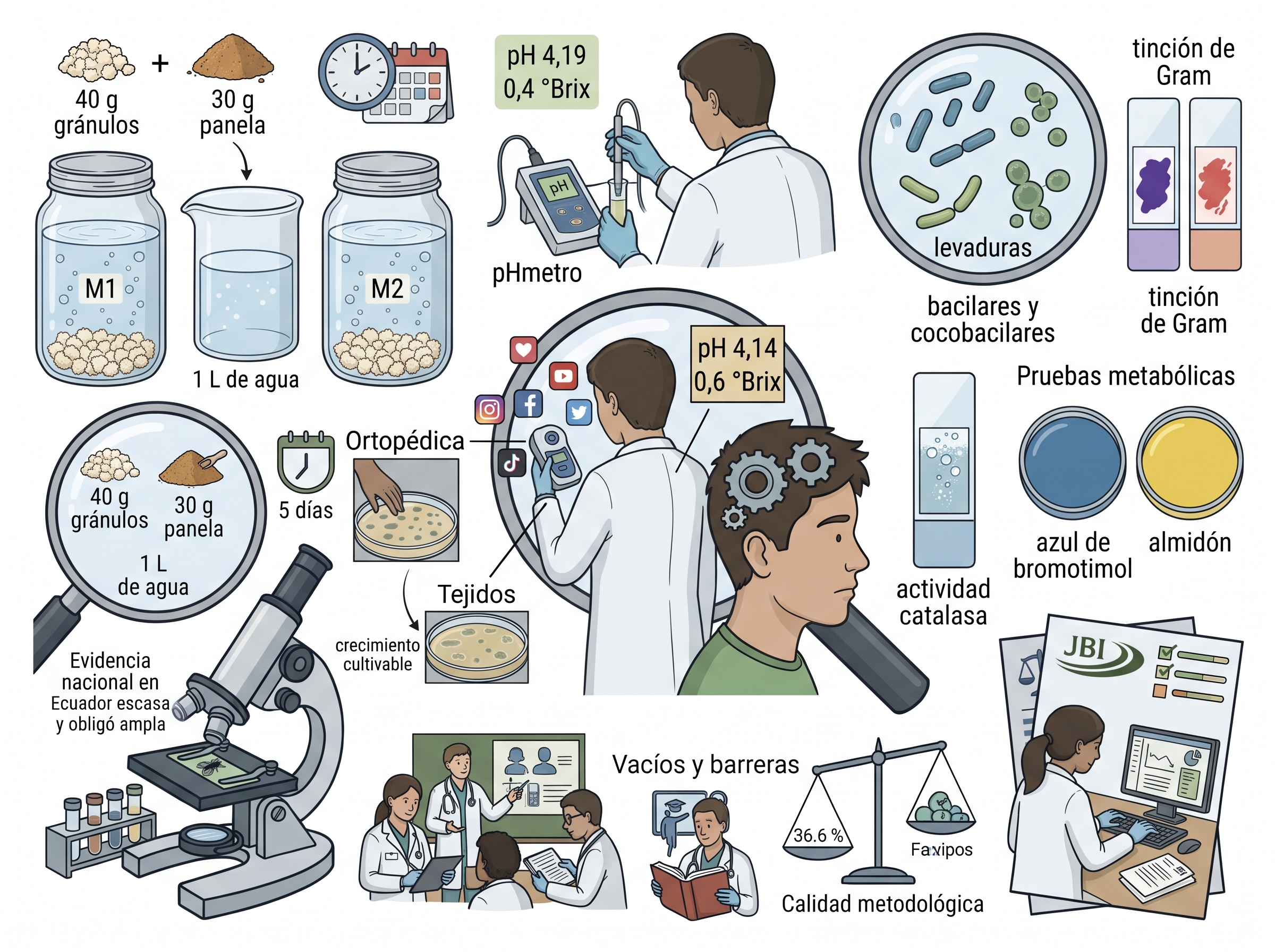
El kéfir de agua es un sistema fermentativo formado por comunidades de bacterias y levaduras cuya composición depende del inóculo y de las condiciones de fermentación. El objetivo fue caracterizar preliminarmente las propiedades fisicoquímicas, microbiológicas cultivables, microscópicas y fenotípicas de dos fermentos independientes preparados a partir de un mismo lote de gránulos. Cada unidad se preparó con 40 g de gránulos, 30 g de panela comercial amarilla y 1 L de agua embotellada, y se evaluó después de cinco días. En M1 y M2 se determinaron pH y sólidos solubles mediante tres lecturas técnicas por muestra; además, se evaluaron crecimiento en un medio nutritivo de formulación propia, morfología por tinción de Gram, actividad catalasa y respuesta metabólica exploratoria en medio con almidón y azul de bromotimol. M1 presentó pH 4,19 y 0,4 °Brix, y M2 pH 4,14 y 0,6 °Brix. Ambas muestras mostraron crecimiento cultivable. En el material cultivado se observaron morfotipos bacilares y cocobacilares, estructuras compatibles con levaduras y una reacción compatible con actividad catalasa. El medio con almidón mostró cambios de color compatibles con modificación del pH. Estos datos constituyen una línea base del fermento para ensayos posteriores con más unidades de fermentación y métodos moleculares
Descargas
Referencias
Alarcón, A. L., Palacios, L. M., Osorio, C., Narváez, P. C., Heredia, F. J., Orjuela, A., & Hernanz, D. (2021). Chemical characteristics and colorimetric properties of non-centrifugal cane sugar (“panela”) obtained via different processing technologies. Food Chemistry, 340, 128183. https://doi.org/10.1016/j.foodchem.2020.128183 DOI: https://doi.org/10.1016/j.foodchem.2020.128183
Amann, R. I., Ludwig, W., & Schleifer, K. H. (1995). Phylogenetic identification and in situ detection of individual microbial cells without cultivation. Microbiological Reviews, 59(1), 143–169. https://doi.org/10.1128/mr.59.1.143-169.1995 DOI: https://doi.org/10.1128/mr.59.1.143-169.1995
Arrieta-Echeverri, M. C., Fernández, G. J., Duarte-Riveros, A., Correa-Álvarez, J., Bardales, J. A., Villanueva-Mejía, D. F., & Sierra-Zapata, L. (2023). Multi-omics characterization of the microbial populations and chemical space composition of a water kefir fermentation. Frontiers in Molecular Biosciences, 10, 1223863. https://doi.org/10.3389/fmolb.2023.1223863 DOI: https://doi.org/10.3389/fmolb.2023.1223863
Beveridge, T. J. (2001). Use of the Gram stain in microbiology. Biotechnic & Histochemistry, 76(3), 111–118. https://doi.org/10.1080/bih.76.3.111.118 DOI: https://doi.org/10.1080/bih.76.3.111.118
de Carvalho Alves, J., de Souza, C. O., de Matos Santos, L., Viana, S. N. A., de Jesus Assis, D., Tavares, P. P. L. G., Requião, E. dos R., Ferro, J. M. R. B. dos S., & Roselino, M. N. (2024). Licuri kernel (Syagrus coronata (Martius) Beccari): A promising matrix for the development of fermented plant-based kefir beverages. Foods, 13(13), 2056. https://doi.org/10.3390/foods13132056 DOI: https://doi.org/10.3390/foods13132056
Davidović, S. Z., Miljković, M. G., Antonović, D. G., Rajilić-Stojanović, M. D., & Dimitrijević-Branković, S. I. (2015). Water kefir grain as a source of potent dextran producing lactic acid bacteria. Hemijska Industrija, 69(6), 595–604. https://doi.org/10.2298/HEMIND140925083D DOI: https://doi.org/10.2298/HEMIND140925083D
Fiorda, F. A., de Melo Pereira, G. V., Thomaz-Soccol, V., Rakshit, S. K., Pagnoncelli, M. G. B., Vandenberghe, L. P. de S., & Soccol, C. R. (2017). Microbiological, biochemical, and functional aspects of sugary kefir fermentation: A review. Food Microbiology, 66, 86–95. https://doi.org/10.1016/j.fm.2017.04.004 DOI: https://doi.org/10.1016/j.fm.2017.04.004
Garmendia, G., Gyenes, F., Alvarez, A., Arbildi, E., Giménez, S., Gonda, M., & Vero, S. (2026). Dynamic microbiota in water kefir: Microbial shift and ecological selection during fermentation. BMC Microbiology, 26, 271. https://doi.org/10.1186/s12866-025-04461-y DOI: https://doi.org/10.1186/s12866-025-04461-y
Gökırmaklı, Ç., Karagül Yüceer, Y., & Güzel-Seydim, Z. B. (2023). Chemical, microbial, and volatile changes of water kefir during fermentation with economic substrates. European Food Research and Technology, 249(7), 1717–1728. https://doi.org/10.1007/s00217-023-04242-9 DOI: https://doi.org/10.1007/s00217-023-04242-9
Gomes, R. J., Borges, M. F., Rosa, M. F., Castro-Gómez, R. J. H., & Spinosa, W. A. (2018). Acetic acid bacteria in the food industry: Systematics, characteristics and applications. Food Technology and Biotechnology, 56(2), 139–151. https://doi.org/10.17113/ftb.56.02.18.5593 DOI: https://doi.org/10.17113/ftb.56.02.18.5593
Gulitz, A., Stadie, J., Wenning, M., Ehrmann, M. A., & Vogel, R. F. (2011). The microbial diversity of water kefir. International Journal of Food Microbiology, 151(3), 284–288. https://doi.org/10.1016/j.ijfoodmicro.2011.09.016 DOI: https://doi.org/10.1016/j.ijfoodmicro.2011.09.016
Güzel-Seydim, Z. B., Şatır, G., & Gökırmaklı, Ç. (2023). Use of mandarin and persimmon fruits in water kefir fermentation. Food Science & Nutrition, 11(10), 5890–5897. https://doi.org/10.1002/fsn3.3561 DOI: https://doi.org/10.1002/fsn3.3561
Jaffé, W. R. (2015). Nutritional and functional components of non centrifugal cane sugar: A compilation of the data from the analytical literature. Journal of Food Composition and Analysis, 43, 194–202. https://doi.org/10.1016/j.jfca.2015.06.007 DOI: https://doi.org/10.1016/j.jfca.2015.06.007
Lamont, J. R., Wilkins, O., Bywater-Ekegärd, M., & Smith, D. L. (2017). From yogurt to yield: Potential applications of lactic acid bacteria in plant production. Soil Biology and Biochemistry, 111, 1–9. https://doi.org/10.1016/j.soilbio.2017.03.015 DOI: https://doi.org/10.1016/j.soilbio.2017.03.015
Laureys, D., Aerts, M., Vandamme, P., & De Vuyst, L. (2018). Oxygen and diverse nutrients influence the water kefir fermentation process. Food Microbiology, 73, 351–361. https://doi.org/10.1016/j.fm.2018.02.007 DOI: https://doi.org/10.1016/j.fm.2018.02.007
Laureys, D., Aerts, M., Vandamme, P., & De Vuyst, L. (2019). The buffer capacity and calcium concentration of water influence the microbial species diversity, grain growth, and metabolite production during water kefir fermentation. Frontiers in Microbiology, 10, 2876. https://doi.org/10.3389/fmicb.2019.02876 DOI: https://doi.org/10.3389/fmicb.2019.02876
Laureys, D., & De Vuyst, L. (2014). Microbial species diversity, community dynamics, and metabolite kinetics of water kefir fermentation. Applied and Environmental Microbiology, 80(8), 2564–2572. https://doi.org/10.1128/AEM.03978-13 DOI: https://doi.org/10.1128/AEM.03978-13
Laureys, D., & De Vuyst, L. (2017). The water kefir grain inoculum determines the characteristics of the resulting water kefir fermentation process. Journal of Applied Microbiology, 122(3), 719–732. https://doi.org/10.1111/jam.13370 DOI: https://doi.org/10.1111/jam.13370
Laureys, D., Leroy, F., Hauffman, T., Raes, M., Aerts, M., Vandamme, P., & De Vuyst, L. (2021). The type and concentration of inoculum and substrate as well as the presence of oxygen impact the water kefir fermentation process. Frontiers in Microbiology, 12, 628599. https://doi.org/10.3389/fmicb.2021.628599 DOI: https://doi.org/10.3389/fmicb.2021.628599
Laureys, D., Leroy, F., Vandamme, P., & De Vuyst, L. (2022). Backslopping time, rinsing of the grains during backslopping, and incubation temperature influence the water kefir fermentation process. Frontiers in Microbiology, 13, 871550. https://doi.org/10.3389/fmicb.2022.871550 DOI: https://doi.org/10.3389/fmicb.2022.871550
Lima, A. L. B. C., Pinheiro, L. R., de Souza, B. J. F., & Pereira, A. F. (2024). Different sources of sucrose in water kefir fermentation. Brazilian Journal of Food Technology, 27, e2024012. https://doi.org/10.1590/1981-6723.01224 DOI: https://doi.org/10.1590/1981-6723.01224
Lynch, K. M., Wilkinson, S., Daenen, L., & Arendt, E. K. (2021). An update on water kefir: Microbiology, composition and production. International Journal of Food Microbiology, 345, 109128. https://doi.org/10.1016/j.ijfoodmicro.2021.109128 DOI: https://doi.org/10.1016/j.ijfoodmicro.2021.109128
Marsh, A. J., O’Sullivan, O., Hill, C., Ross, R. P., & Cotter, P. D. (2013). Sequence-based analysis of the microbial composition of water kefir from multiple sources. FEMS Microbiology Letters, 348(1), 79–85. https://doi.org/10.1111/1574-6968.12248 DOI: https://doi.org/10.1111/1574-6968.12248
Mokoena, M. P., Omatola, C. A., & Olaniran, A. O. (2021). Applications of lactic acid bacteria and their bacteriocins against food spoilage microorganisms and foodborne pathogens. Molecules, 26(22), 7055. https://doi.org/10.3390/molecules26227055 DOI: https://doi.org/10.3390/molecules26227055
Monar, M., Dávalos, I., Zapata, S., Caviedes, M., & Ramírez-Cárdenas, L. (2014). Caracterización química y microbiológica del kéfir de agua artesanal de origen ecuatoriano. ACI Avances en Ciencias e Ingenierías, 6(1), B60–B66. https://doi.org/10.18272/aci.v6i1.160 DOI: https://doi.org/10.18272/aci.v6i1.160
Pendón, M. D., Bengoa, A. A., Iraporda, C., Medrano, M., Garrote, G. L., & Abraham, A. G. (2022). Water kefir: Factors affecting grain growth and health-promoting properties of the fermented beverage. Journal of Applied Microbiology, 133(1), 162–180. https://doi.org/10.1111/jam.15385 DOI: https://doi.org/10.1111/jam.15385
Raman, J., Kim, J.-S., Choi, K. R., Eun, H., Yang, D., Ko, Y.-J., & Kim, S.-J. (2022). Application of lactic acid bacteria (LAB) in sustainable agriculture: Advantages and limitations. International Journal of Molecular Sciences, 23(14), 7784. https://doi.org/10.3390/ijms23147784 DOI: https://doi.org/10.3390/ijms23147784
Sin, P. Y., Tan, S. H., Asras, M. F. F., Lee, C. M., & Lee, T. C. (2024). Probiotic growth pattern and physicochemical evaluation of water kefir fermentation. Malaysian Applied Biology, 53(2), 21–30. https://doi.org/10.55230/mabjournal.v53i2.2742 DOI: https://doi.org/10.55230/mabjournal.v53i2.2742
Stadie, J., Gulitz, A., Ehrmann, M. A., & Vogel, R. F. (2013). Metabolic activity and symbiotic interactions of lactic acid bacteria and yeasts isolated from water kefir. Food Microbiology, 35(2), 92–98. https://doi.org/10.1016/j.fm.2013.03.009 DOI: https://doi.org/10.1016/j.fm.2013.03.009
Tamang, J. P., Watanabe, K., & Holzapfel, W. H. (2016). Review: Diversity of microorganisms in global fermented foods and beverages. Frontiers in Microbiology, 7, 377. https://doi.org/10.3389/fmicb.2016.00377 DOI: https://doi.org/10.3389/fmicb.2016.00377
Taşkın, B., & Akköprü, A. (2020). Antibacterial activity of different kefir types against various plant pathogenic bacteria. Journal of Agricultural Sciences (Tarım Bilimleri Dergisi), 26(3), 316–323. https://doi.org/10.15832/ankutbd.499790 DOI: https://doi.org/10.15832/ankutbd.499790
Tavares, P., Mamona, C. T. P., Nascimento, R. Q., dos Anjos, E. A., de Souza, C. D., Almeida, R. C. C., Mamede, M. E. O., & Magalhães-Guedes, K. (2023). Non-conventional sucrose-based substrates: Development of non-dairy kefir beverages with probiotic potential. Fermentation, 9(4), 384. https://doi.org/10.3390/fermentation9040384 DOI: https://doi.org/10.3390/fermentation9040384
Tireki, S. (2025). Influence of water properties on the physicochemical and sensorial parameters of water kefir. Journal of Culinary Science & Technology, 23(3), 579–599. https://doi.org/10.1080/15428052.2024.2303002 DOI: https://doi.org/10.1080/15428052.2024.2303002
Verce, M., De Vuyst, L., & Weckx, S. (2019). Shotgun metagenomics of a water kefir fermentation ecosystem reveals a novel Oenococcus species. Frontiers in Microbiology, 10, 479. https://doi.org/10.3389/fmicb.2019.00479 DOI: https://doi.org/10.3389/fmicb.2019.00479
Wilches-López, L., Correa-Espinal, A., Pérez-Monterroza, E. J., & Rojas, L. F. (2023). Metataxonomic and metabolic evaluation of three water kefir microbiomes cultured in sugar cane juice. Journal of Food Process Engineering, 46(11), e14281. https://doi.org/10.1111/jfpe.14281 DOI: https://doi.org/10.1111/jfpe.14281
Publicado
Número
Sección
Licencia
Derechos de autor 2026 Cristian Fernando Izquierdo-Velasco, Mercedes Susana Carranza-Patiño, Patricia Cecibel Villa Zambrano, José Xavier Serrano-Recalde, Robinson J. Herrera-Feijoo (Autor/a)

Esta obra está bajo una licencia internacional Creative Commons Atribución-NoComercial 4.0.
Cómo citar


 :
